
Menu
iPhone Duo vs iPad: Do You Still Need a Tablet?
Somewhere around 2021 I stopped watching Apple’s September event live. I’d skim the highlights later and land on the same verdict every time: nice phone, slightly better than the one already in my pocket, not worth the money. Faster chip, bigger camera bump, a new colour that sells out by lunch. You could set your watch by it.
So I wasn’t expecting much this year, and for most of the presentation I got exactly that. Then Apple unfolded a phone on stage, and for the first time in ages I put down what I was doing and paid attention.
I’m not going to tell you the iPhone Duo is a must-buy. There are at least two good reasons to wait, and one of them has a dollar sign in front of it. But as an idea, it’s the first iPhone in years that made me think about how I use my devices instead of which one has the nicer camera. It also planted a question I haven’t been able to shake: if my phone can open into something close to a small tablet, what exactly is my iPad for?
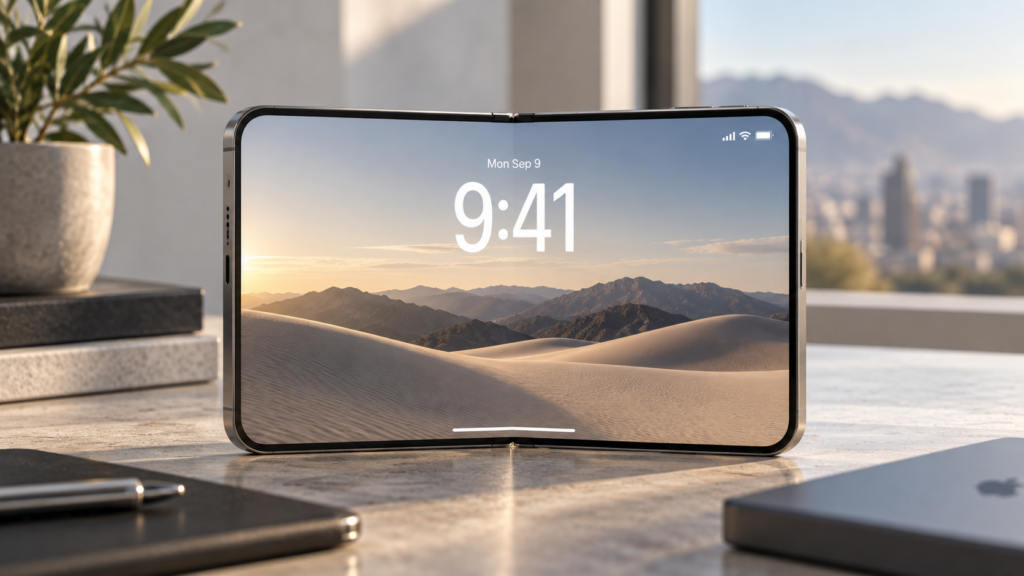
iPhone Duo : What Apple actually built
The basics first. Closed, the Duo is about the footprint of a passport, with a 5.4-inch screen on the front. Open it like a book and there’s a 7.6-inch display inside, the largest Apple has ever put on an iPhone. Apple says the outer screen gives you roughly 90 percent of the usable area of an iPhone 18 Pro, and both panels share the same aspect ratio, so apps should move between them without awkward gaps.
Under the glass there’s a new A20 Pro chip, a battery in each half, a grade 5 titanium frame and a hinge Apple says is built for years of use. It runs iOS 27, adjusted for the extra space and the odd orientations that come with it.
Solid spec sheet. Not what got me, though.
The compromise every phone forces on you
Buying a phone has always meant picking a size and living with it. Either it fits in a jacket pocket and doesn’t feel ridiculous held to your ear, or it’s a slab with a gorgeous display you’ll never comfortably use one-handed. Most of us choose and quietly resent the trade-off.
The Duo’s pitch is that you don’t have to. Folded, it’s a normal phone for the ninety percent of the day spent checking a message, skipping a song or tapping to pay for a coffee. Open, it’s what you reach for on the couch, on the train, or when work follows you home. Same device, same apps, same SIM. It sounds almost too simple to be a big deal, which is usually a sign that it is one.
The iPad in the room
Here’s where my thinking went sideways. I own an iPad. I like my iPad. And if I’m truthful about what I use it for, the list is short: watching things in bed, reading longer articles, a recipe propped up in the kitchen, and email when I can’t be bothered to open the laptop.
I suspect that describes a lot of iPad owners, and that’s exactly the audience the Duo quietly threatens. Nobody with a 13-inch iPad Pro and an Apple Pencil is going to look at a 7.6-inch phone and feel replaced. But an iPad mini? That’s a much less comfortable comparison for Apple, especially now that Apple Pencil support is coming to the Duo later this year. A phone that opens to nearly the size of Apple’s smallest tablet, takes the same stylus, lives in your pocket and is already signed into everything makes the second device start to feel like clutter.
My first reaction to the announcement wasn’t “Apple made a foldable.” It was closer to “I might stop carrying my iPad.” I doubt Apple meant to send that message. Plenty of people heard it anyway.
Book, not flip, was the right call for iPhone Duo
I was relieved Apple went with a horizontal, book-style fold instead of a clamshell. A flip phone is cute, but every basic task means opening it first, and that wears thin in about a week. The Duo’s outer screen is meant to be a full phone rather than a status window, so the fold stays optional.
That distinction will decide whether people still like this thing in March. A foldable that makes ordinary phone tasks more annoying in exchange for occasional wow moments is a gadget. One that behaves like a regular iPhone until you decide otherwise is a tool.
Multitasking is the real product for iPhone Duo
“Bigger screen” is not a reason to spend two thousand dollars on a phone. Doing two things at once might be.
Apple’s demos leaned hard on this: Split View with a video call on one side and a document on the other, messaging next to a video, app pairs you can save and reopen together. None of that is thrilling on its own, but together it describes how I actually work away from my desk, which is exactly when a phone screen starts to feel like a keyhole.
Phones have had laptop-grade performance for years; the bottleneck is the glass, not the chip. Doubling the iPhone’s surface area matters more than any processor bump Apple has shipped this decade.
Apple’s advantage is that this is still iOS. Samsung and several other brands have sold foldables since 2019; Apple is unmistakably late. But being first has never been Apple’s game. It waits until it thinks it can make a category feel ordinary. Foldables remain a niche, under five percent of smartphone sales by most analyst estimates, largely because they’ve felt like enthusiast hardware. Put one in every Apple Store and that perception can change quickly.
Then there's the price for iPhone Duo
Two thousand dollars. Fine, $1,999 in the US, but the missing dollar fools nobody. Max out the storage and you’re at $3,199, which is MacBook Pro money for a phone.
That number does something awkward to my iPad argument. If a regular iPhone plus an iPad mini costs about the same as one Duo, consolidating doesn’t save you anything. What you’re paying for is convenience: one thing to charge, one cellular plan, one camera, one set of apps, one object in your pocket that grows when you need it to. For some people that’s easily worth the premium. For most, I suspect it isn’t yet.
That’s why I’ve come to see the first Duo less as a phone to recommend and more as a preview. The interesting moment isn’t 2026; it’s whenever Apple gets this design down to something closer to Pro Max money. That’s when choosing between a flat iPhone and a folding one gets hard, and hard choices are where categories shift.
The questions a keynote can't answer for iPhone Duo
Set price aside and durability is where I’d want proof before spending my own money. Titanium and a precision hinge sound reassuring, but a conventional phone doesn’t bend its display a few hundred times a week or run its entire structure through a mechanical joint. I’d want to see one after a year of pocket lint, car keys and clumsy drops. How visible is the crease? Does the hinge loosen? What does an inner-screen repair cost, and what happens to resale value once there’s a mark down the middle?
Early adopters will find out so the rest of us don’t have to. I’m just not sure I want to be one at this price.
Small tricks that add up
Two smaller things turned out to be more interesting than expected. The first is the camera. Because the phone can hold itself half-open in a tent shape, it becomes its own tripod: set it on a table for a group photo or a video call and stop leaning it against a water glass. The hinge stops being a compromise and starts being a feature.
The second is AI. Apple Intelligence and the new Siri are on board, but the real change is having room for them. On a normal phone an assistant has to take over the whole screen to do anything. On the open Duo it can sit beside whatever you’re working on, a document on one side and a summary on the other. The next step for smartphone AI may have less to do with smarter models and more to do with giving them somewhere to live.
Would I buy iPhone Duo?
As technology, I’m fascinated. As a purchase, I’m cautious. My plan is to go to an Apple Store and be that person: open and close it thirty times, type on the outer screen, run two apps, watch a clip, stare at the crease, then shove it in my pocket and see whether the thickness bugs me. The only question that really matters is whether I’d unfold it several times a day, every day. If yes, the premium starts to make sense. If I’d mostly keep it closed, it’s a very expensive iPhone.
This first version isn’t really the point, though. The original Apple Watch was a muddled product; the first iPhone couldn’t copy and paste. What matters is whether the Duo proves people want a phone that changes shape. If it does, the third or fourth generation, thinner and lighter and cheaper with a hinge nobody thinks about, is the one that rewrites Apple’s lineup.
For years the only question a new iPhone asked me was whether it was worth upgrading. The Duo asks a better one: could one device replace two? I don’t think it kills the iPad, and it certainly doesn’t at this price. But it’s the first iPhone in a long while that made me look at the tablet on my coffee table and wonder how much longer it’ll be there.
Recent Posts

DHG
Company
© 2026 Daily How Guide. All Rights Reserved.